Categories

Archives

Subscribe

CNBC: Is America Losing Its Edge?

“Squawk on the Street”
A new survey predicts U.S. will slip in global competitiveness over next 5 years, with Michele Wucker, World Policy Institute and Greg Valliere, Potomac Research Group.

June 23 2010
Tags: business, competitiveness, international

Arizona Republic on Counterproductive Rhetoric

Calls to ’secure border first’ undermine reform

by Dennis Wagner
The Arizona Republic
June 20, 2010

Amid a growing national angst about illegal immigration, Americans keep hearing a chorus: Secure the border first. Then talk about immigration reform….

……..Michele Wucker, executive director of the World Policy Institute, a nonpartisan think tank, said border incursions happen wherever two countries have unequal economies or black-market trade.

Wucker, author of “Lockout: Why America Keeps Getting Immigration Wrong,” said those who demand a sort of iron curtain prior to policy change are obstructionists: “It means don’t ever come up with a workable system.”

Arizona has the most to gain from a new policy paradigm, Wucker argued, because the status quo made the state a thoroughfare for smuggling. Yet the state’s political leaders, caught up in a wave of public opinion, no longer press for reform.

“When I see John McCain saying, ‘Build the dang fence,’ I’m very sad,” Wucker said. “Arizona would benefit more than any other state from immigration reform at a national level. They’re really cutting off their nose to spite their face.”

Tags: Arizona, immigration

Newsweek on Dominican-Haitian Relations

An April 15, 2010 of Newsweek article by Jeneen Interlandi, “Enemies: A Love Story,” quotes me about the positive changes in the relationship between the Dominican Republic and Haiti since the January earthquake.

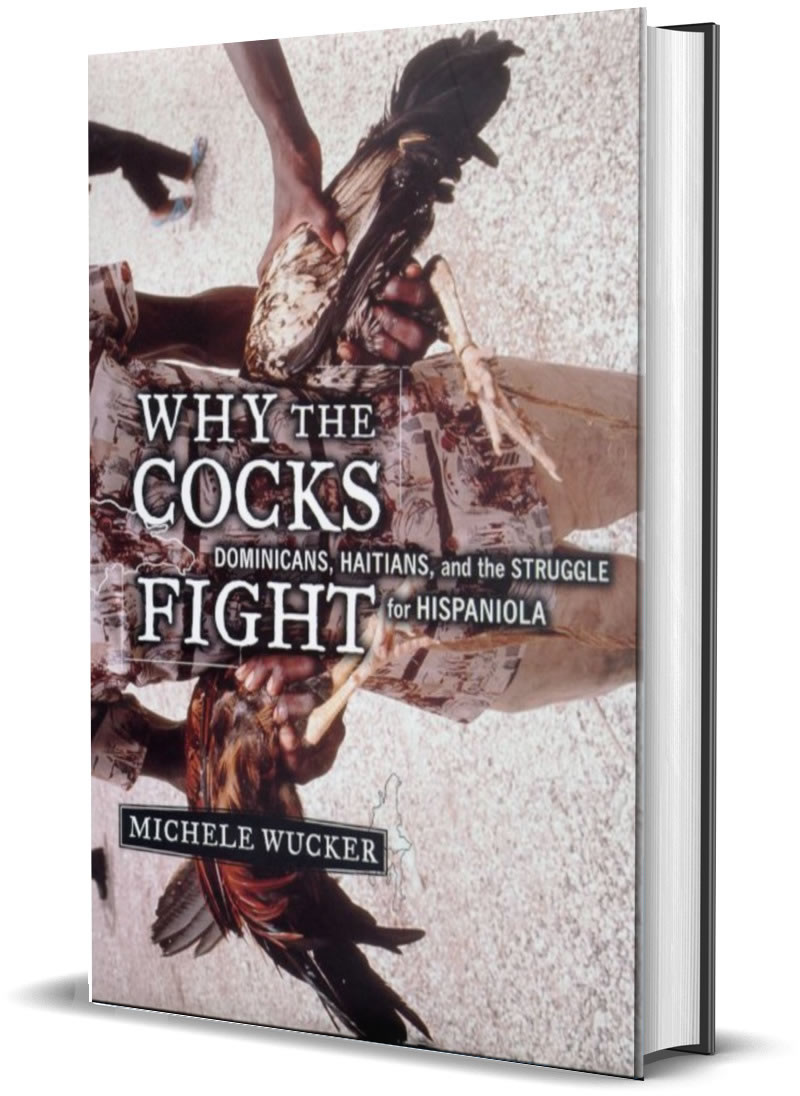
“We’ve had zero reports of violent attacks since the quake,” says Michele Wucker, executive director of the World Policy Institute and author of Why the Cocks Fight: Dominicans, Haitians, and the Struggle for Hispaniola. Dominican officials have also been instrumental in helping international aid groups access their earthquake-ravaged neighbor, Wucker says.

Follow this link to read the whole article. The article is available in French at nouvelobs.com as “Comment Haïti et la République Dominicaine ont fait la paix.”

Tags: Dominican Republic, earthquake, Haiti, international

PublicAgenda.org -Immigration Reform and Climate Change

Immigration Reform & Climate Change: Two Hot-Button Issues Intersect cross posted at www.publicagenda.org and the World Policy Blog

In the days following the earthquake that destroyed Port-au-Prince and killed over 200,000 people, the United States granted temporary protected status (TPS) to those undocumented immigrants from Haiti who were living in the United States prior to the date of the quake. It was the right thing to do after such an “act of God.” Yet, it stood in stark contrast to the failure of the United States to use its migration policy to help Haitians in 2008, when the island was struck by a series of natural disasters that were arguably man-made—a series of storms made increasingly more frequent and violent by rising sea levels and temperatures caused by greenhouse gas emissions.

Posted March 19, 2010. For the full article visit the links above.

Tags: climate change, earthquake, Haiti, immigration, migration

Interview with Quebec Immigration Minister Yolande James

Immigrant Policy in Québec:  Successes and Lessons Learned

Video of my discussion with Yolande James, Minister of Cultural Communities, Government of Quebec, at the World Policy Institute April 7, 2010.

Canada has long taken pride in its reputation for successfully welcoming immigrants. Nevertheless, like other immigrant destinations, it has faced challenges like combating racism, matching immigrants’ skills with appropriate jobs, and ensuring that immigrants have the language skills they need. Under a bilateral agreement with the Canadian federal government, Québec is able to make its own policies on the immigrants it selects, and to design and implement its own policies on integration and diversity -that is, “immigrant” policies, and not just “immigration” policies.

Québec’s Minister of Immigration and Cultural Communities Yolande James, the daughter of Canadian citizens who emigrated from St. Lucia and St. Vincent, spoke with WPI Executive Director Michele Wucker about Québec’s successes and the lessons that it has learned.  Minister James also spoke about how Québec has used immigration policies to support Haiti following the January 12 earthquake.

Tags: Canada, earthquake, Haiti, immigration, integration, migration

Japan Times article on non-citizen voting

Japan Times

Tuesday, Feb. 23, 2010
How the rest of the world deals with aliens at the ballot box
By SARAH NOORBAKHSH

Excerpt:

Acknowledging the rights of immigrant groups, “recognizing special ties among particular groups of countries” and reciprocation are often part and parcel of granting suffrage, says Michele Wucker, executive director of the World Policy Institute. The EU, the Commonwealth, Brazil, Portugal and Spain are cases in point. However, the decision in South Korea had the effect of enfranchising mostly Taiwanese immigrants rather than being a “quid pro quo” reform benefiting Japan, and the country has thus far only indicated that it hopes for a similar move here in Japan. Also worth noting is that whereas 6,000 noncitizens benefited from the law change in South Korea, there are over 900,000 permanent foreign residents in Japan, including over 400,000 “special permanent residents” — mostly Koreans and Taiwanese who lived in Japan before and during the war, as well as their descendants.

So what about the argument that, rather than give voting rights to permanent residents, they should be encouraged to naturalize instead? This attitude is prevalent in North America, where noncitizen voting rights have been rolled back. In contrast, Chile introduced alien suffrage to in part to compensate for its slow, inefficient nationalization system.

“If people feel that they are part of a community with their neighbors, then they are more likely to embrace national values and even apply for citizenship as well,” suggests Wucker. Indeed, movements in Toronto as well as Rome have used this argument in pressing for the involvement of immigrant groups in local politics, though demonstrating objectively that granting foreigners the vote leads to an increased demand for naturalization has proved a challenge.

CLICK TO READ FULL STORY

Tags: citizenship, immigration policy, Japan, migration, politics

Beyond Relief: Council on Foreign Relations Haiti panel Feb 18

Video, audio, and transcript from “Beyond Relief: Helping Haiti,” a Council on Foreign Relations panel discussion in which Michele participated February 18, 2010.

Beyond Relief: Helping Haiti (Transcript)

Beyond Relief: Helping Haiti (Audio)

Speakers:

Pamela Cox, Vice President, Latin America and the Caribbean Region, World Bank Group

Arvind Subramanian, Senior Fellow, Peterson Institute for International Economics

Michele Wucker, Executive Director, World Policy Institute

Presider:

Marcus Mabry, International Business Editor, New York Times

Watch experts discuss the political and economic challenges facing Haiti and the role foreign aid can play in the country’s recovery and development.

Tags: aid policy, earthquake, Haiti, immigration policy, international development, international policy

Slate.fr: Les Haïtiens doivent être partie prenante de la reconstruction

Les Haïtiens doivent être partie prenante de la reconstruction

Il faut à tout prix éviter de refaire les erreurs du passé et utiliser la reconstruction comme une occasion d’engager la société civile haïtienne…..

  • Par Michele Wucker
  • Michele Wucker est la directrice exécutive du World Policy Institute (Institut des politiques mondiales) et l’auteure de Why the Cocks Fight: Dominicans, Haitians, and the Struggle for Hispaniola [Pourquoi le coq se bat: Dominicains, Haïtiens et le combat pour Hispaniola]

(translation of the article that appeared on ForeignPolicy.com Jannuary 19th)

Tags: development, earthquake, Haiti, international policy

Jan 26: Linking Ethics and Self-Interest in Human Mobility

Published in Carnegie Council Policy Innovations

part of a collection from the December “The Right to Move?” conference in Tokyo.

January 26, 2010

Facing demographic and economic challenges, countries around the world are reconsidering the policies that govern migrant rights—the basis on which people are allowed to enter a country, the access that non-citizens have to services and rights, and the ability of non-citizens to naturalize. Decisions about who gets the right to move have significant consequences for the citizens, societies, and economies of host and sending countries alike.

The central question for many countries is: Who is admitted and how? In countries where ethnicity or family ties are priority criteria, the ethics of deciding who enters are closely tied to national conceptions of self-interest and identity. Sometimes these conceptions conflict, as Germany found when reconciling its long-standing policy of admitting people based on blood ties with its national desire to provide hospice to refugees. Admissions decisions also have consequences for sending countries which in turn ripple back to host countries when borders are weak and economic pull is strong.

Immigration rights advocates often make a moral argument for liberalizing immigration policy. No matter how good the moral case is, however, under the fraught politics of immigration the only arguments that will succeed are those that make a strong case for the self-interest of the host society. Yet the moral arguments are not necessarily opposed to self-interest; in fact, they often coincide. Continue reading Jan 26: Linking Ethics and Self-Interest in Human Mobility

Tags: immigration policy, Japan, migration

Toronto Star Jan 23-This little (Creole) piggy

This little (Creole) piggy once stood for Haitian pride

That fact should be top of mind as leaders gather in Montreal this week to plan country’s rebuilding

by Kenneth Kidd

follow this link for the full story from the Toronto Star.

My two cents:

The danger, says Michele Wucker, executive director of the World Policy Institute in New York, is that talks could get mired in an ideological debate over the role of the private sector and the state in Haiti’s future.

“You need both,” says Wucker. “You need an engaged private sector, a strong state, and you need accountability for both.

“In the best-case scenario, the rebuilding process is done in such a way that Haitian civil society is engaged, that there’s a way for communities to communicate what their priorities are.”

And whatever the eventual details of that reconstruction, attaining one legacy may well be crucial.

“The focus (should be) on collaboration and building the capacity of the Haitian government, so that, at the end of the process, we have some institutions that can withstand changes of government at the top.”

Tags: development, earthquake, Haiti, international policy